


The role of branding and communication in working with people with disabilities
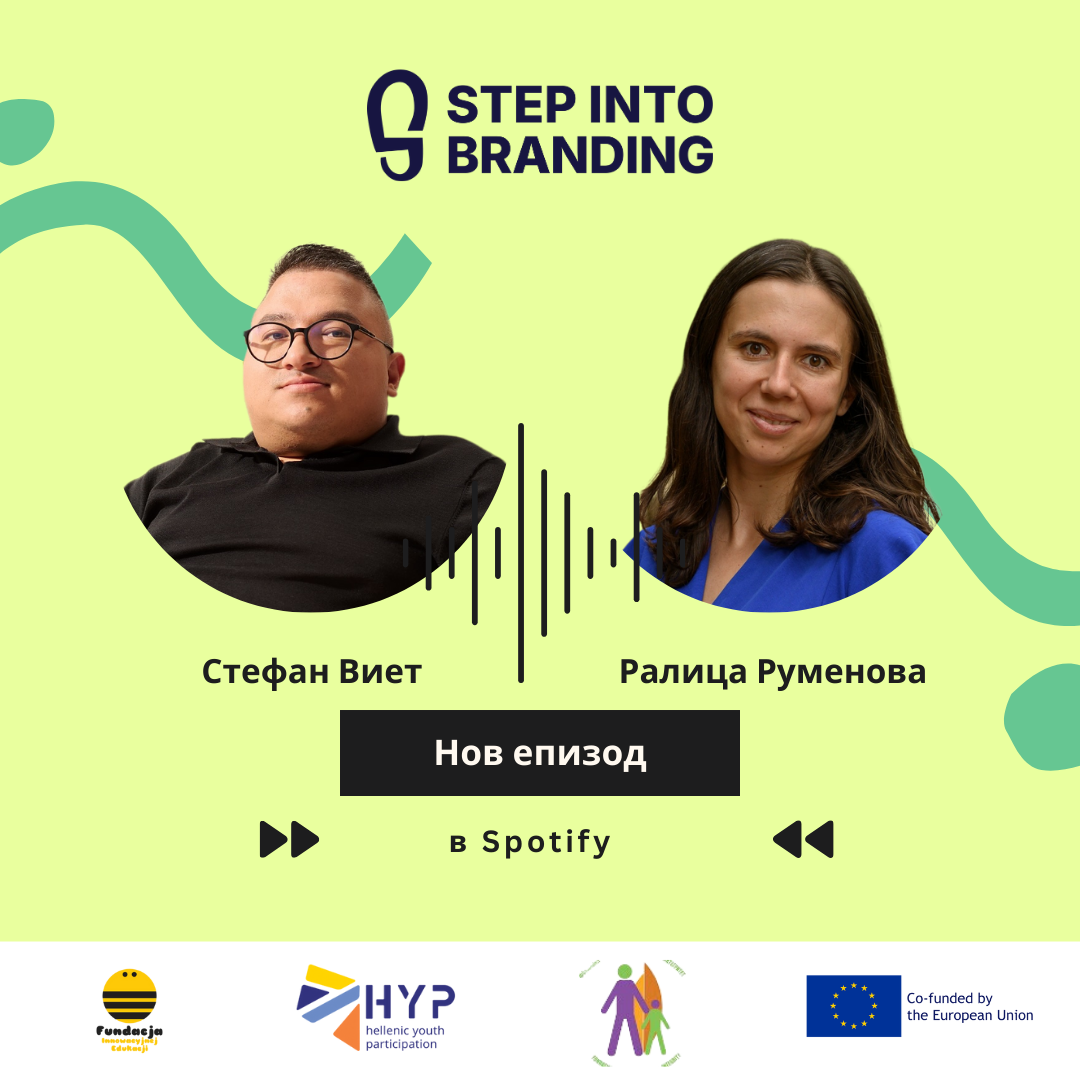
This episode of the podcast Step into Branding is dedicated to the power of branding and communication as tools for social change, with a focus on the visibility and inclusion of people with disabilities. The guest is Stephan Viet – a digital marketer, activist, and co-founder of The Variant, the first hybrid communication agency in Bulgaria led by people with diverse abilities. From the very beginning, it becomes clear that the conversation will not be theoretical, but deeply personal and practical, grounded in Stefan’s real-life experience as a person with a disability and a professional in the field of communications.
Stefan defines “visibility” not as simply being noticed, but as being perceived correctly. For him, true visibility means being seen as a whole person – with a profession, opinions, a sense of humor, weaknesses, and ambitions – rather than solely through the lens of disability. He shares that his personal transformation began when he stopped explaining what he could not do and started showing how he lives and works. In this way, visibility shifts from a defensive stance to a natural presence.
The conversation also addresses the topic of personal branding, especially when one belongs to a marginalized group. According to Stefan, this carries a dual responsibility. On the one hand, he wants to remain authentic and honest with himself and his audience. On the other hand, he is aware that for many people he is their first encounter with someone in a wheelchair, which shapes how they perceive people with disabilities as a whole. His personal brand consciously avoids extremes – he does not want to be seen as either a hero or an exception, but as part of everyday normality.
A significant part of the discussion is devoted to stereotypes. Stefan points out that people with disabilities are often portrayed either as inspirational heroes or as a burden to society. Both images are equally harmful because they strip away the human dimension. He emphasizes that the problem lies less in the bodies of people with disabilities and more in the environment and the way society talks about them. Communication that presents them solely through lack and suffering excludes them, while communication that shows them as active participants in society gives them a voice and a place.
The work of The Variant is presented as an example of this kind of communication. The agency uses branding as a tool for “translation” – translating complex and sensitive topics into a normal, human language. Instead of explaining disabilities, they show life in context: people with disabilities who work, play sports, have families, and pursue interests. This approach avoids both heroization and pity. The Variant also positions itself not as a typical NGO, but as a real business partner that demonstrates to companies that including people with disabilities makes sense and has real potential.
Stefan emphasizes that honesty is the key for a story to be not just heard, but truly understood. Perfect, polished narratives tend to repel audiences because people sense when something is not authentic. This is especially true in the context of social media, where the constant display of a “perfect life” negatively affects mental health. That is why, when talking about accessibility, Stefan chooses to share personal, concrete situations – for example, how the lack of a curb ramp can completely change his day. People understand much better through lived experience than through abstract policies and definitions.
Regarding communication for social causes, he insists on a balance between emotion, facts, and action. Excessive emotion can tire or alienate audiences, while action without meaning becomes mere noise. Strong communication clearly explains why a problem matters, what does not work, what could change, and how the audience can become part of the solution. It is especially important that people with disabilities are active participants in the communication process, not just its subject.
Stefan also draws attention to format. In today’s environment, short videos are the most effective because they are direct, accessible, and allow for human presence. Often, a simple video shot on a phone with a clear message is more powerful than a perfectly produced campaign. This makes communication more democratic and accessible to everyone.
The difference between standard advertising and social communication is also clearly outlined. While advertising sells, social communication builds trust. That is why authentic voices and influencers play an important role – not through exaggeration, but through shared experience. Showing “small wins,” the people behind the cause, and the journey toward a solution is more important than showcasing only the final result.
Toward the end of the conversation, Stefan talks about the fear many people and organizations feel when addressing difference. According to him, this fear stems from the unfamiliar and can be overcome with a simple question, patience, and a willingness to listen. We should not be afraid to make mistakes, because silence is the greatest barrier. Social media, in his view, acts as a magnifying glass – it can amplify stereotypes, but it can also dismantle them, depending on who holds the camera and for what purpose.
Stefan gives concrete examples of real change achieved through communication – from shifts in how children and young people relate to him, to the removal of an absurd and unusable ramp after a video publicly exposed the problem. In conclusion, he summarizes that communication does not simply make people with disabilities visible; it shows that they have always been here. The question is whether society is ready to see them as equals – and Stefan expresses a cautious but clear optimism that this change is already beginning to happen.
You can hear the whole podcast in Bulgarian here.